
Hertford County Criminal Case Files
A criminal court record is the case-level file kept by the Clerk of Superior Court after charges are filed. It can include the warrant or citation reference, charging information, first appearance, bond terms, indictment or information, pleas, motions, hearing entries, verdict or plea result, judgment, sentence, probation, fines, restitution, and court costs. For a closer look at the arrest-to-charge stage before final outcome, use the Hertford County arrest records and charges page.
District Court generally handles misdemeanors, infractions, traffic matters, and preliminary felony steps. Superior Court handles felony trials and pleas after indictment or information, higher-level criminal proceedings, jury trials, and some appeals. Both divisions are part of North Carolina's unified General Court of Justice, and Hertford County is identified by the NC Judicial Branch as Prosecutorial District 7, Superior Court District 7B, and District Court District 7.
The official Judicial Branch expunction help topic is one of the assigned images for this criminal court records page. The image source is NC Judicial Branch expunction guidance.
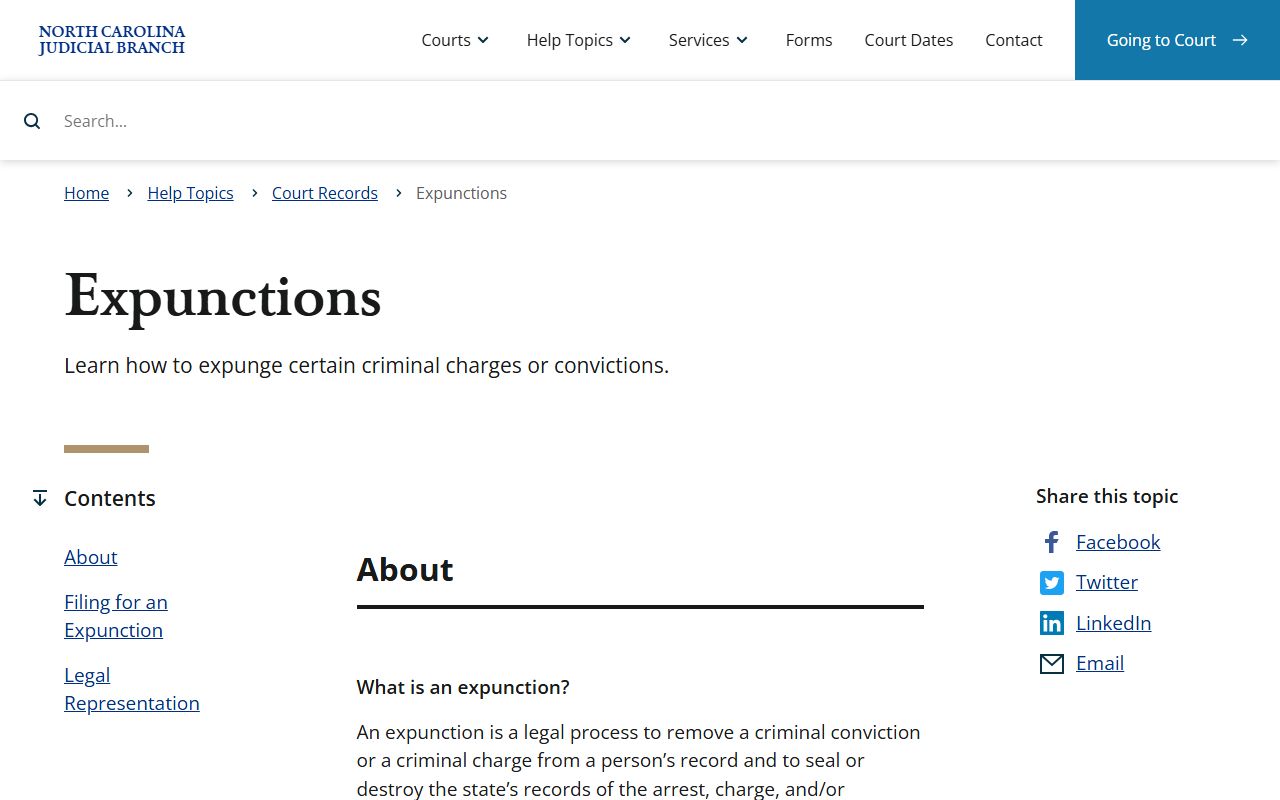
Expunction guidance belongs on a criminal case page because eligible dismissed charges, not-guilty results, and some convictions may later be removed from public access by court order.
Search Hertford County Criminal Court Records
Criminal case lookup starts with NC eCourts Portal Smart Search. Search by defendant name or record number, then use Advanced Filtering Options to set location to Hertford County and narrow by case type, status, and file date. Public users can search without registration, but some records require elevated access or clerk review.
- Open Smart Search in the NC eCourts Portal.
- Search by case number or defendant name in last, first middle suffix format.
- Filter by Hertford County, criminal case type, case status, and file-date range.
- Open the matching case and review charges, docket entries, hearings, disposition, and financial obligations.
- Call the Clerk of Superior Court at 252-358-7100 if a certified copy, older paper file, or restricted-access review is needed.
Public terminals remain a second channel. The Judicial Branch says criminal case information can be searched at a public self-service terminal by defendant name, case number, or victim or witness name. Paper files must be viewed in the county where the case is located.
Hertford County Criminal Case Flow
A criminal record changes as the case moves. A single arrest can produce multiple charges. The District Attorney can dismiss, amend, reduce, or pursue charges. The court file then records hearings, pleas, motions, orders, and final judgment. Bond and custody may begin with the magistrate or jail, but the case file tracks what happens in court.
Case flow: Charges Filed › Arraignment › Pretrial / Motions › Plea or Trial › Disposition › Sentencing
| Stage | What Happens |
|---|---|
| Initial charge and first appearance | Warrant, citation, or other process starts the criminal matter, and release conditions may be set. |
| Arraignment | The defendant is formally advised of the charge and enters or prepares for a plea stage. |
| Pretrial and motions | The docket may show continuances, discovery disputes, suppression motions, bond changes, or scheduling orders. |
| Plea or trial | The case may resolve by plea, dismissal, bench trial, or jury trial depending on court and charge level. |
| Disposition and sentencing | The court records the outcome, judgment, sentence, costs, restitution, probation, or appeal rights. |
What Hertford County Criminal Records Show
The criminal case file should be read field by field. A charge line alone is not the same as a conviction. A docket entry can show a hearing or order without revealing every legal reason behind it. When a certified record matters, the Clerk of Superior Court is the source for the official copy.
| Field | What It Shows |
|---|---|
| Case number | Enterprise Justice or legacy identifier used by Portal and the clerk. |
| Defendant and parties | State and defendant, with attorney details when public. |
| Charges | Offense description, statute, count, severity, agency, warrant or citation reference, and charge status. |
| Bond and release | Release condition, secured or unsecured bond, written promise, custody release, or no-bond status when public. |
| Hearings | Date, time, courtroom, hearing type, judicial officer, continuance, and court date changes. |
| Plea or verdict | Guilty plea, not guilty result, dismissal, deferred result, or other disposition entered by the court. |
| Sentence | Custody, probation, suspended sentence, costs, fines, restitution, attorney fees, and compliance terms. |
North Carolina expunction files are confidential under state law. The assigned image below comes from G.S. 15A-151.
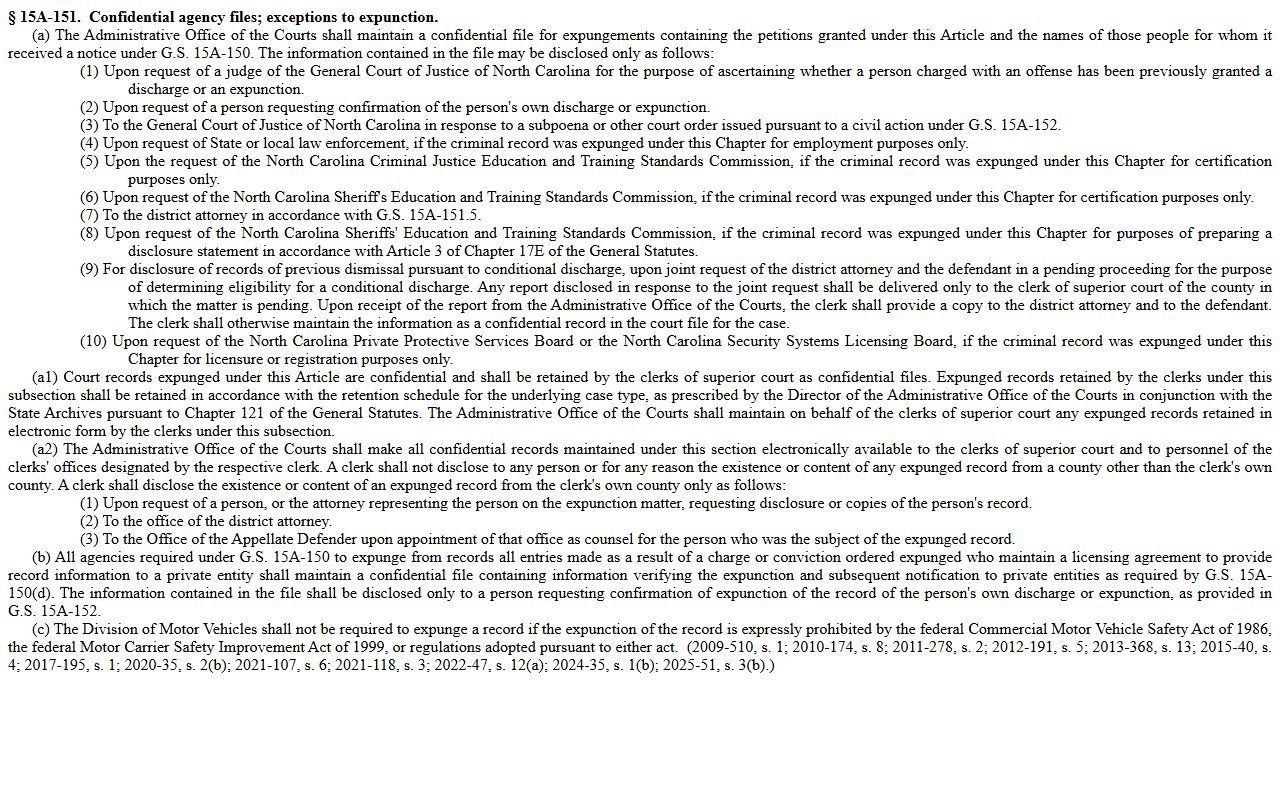
This statute explains why an expunction file may not appear in public search even when a charge once existed in the court system.
Hertford County Charges vs Convictions
A criminal court record can show a charge that did not become a conviction. Charges can be dismissed, reduced, amended, or resolved by not-guilty verdict. A conviction exists only after a guilty plea, guilty verdict, or other judgment of guilt is entered by the court.
| Charge | Conviction | |
|---|---|---|
| Meaning | Formal accusation filed or pursued in court | Final finding or admission of guilt |
| Record status | May remain visible unless dismissed and expunged or restricted | Usually remains visible unless eligible for later relief |
| Case effect | Sets the case in motion | Supports sentence, costs, probation, or other judgment terms |
| Best field to check | Charge status and docket entries | Disposition, judgment, and sentence fields |
Read Dispositions and Sentences
Disposition is the case or charge outcome. It may show guilty, not guilty, dismissed, disposed, judgment entered, compliance pending, or another court status. Sentencing fields can include active time, suspended sentence, supervised probation, restitution, fines, court costs, attorney fees, and payment status.
The District Attorney for Prosecutorial District 7 represents the State in Hertford County criminal cases. Law enforcement and magistrates can start charges or warrants, but the District Attorney decides prosecution strategy, dismissals, pleas, and trial presentation. Defense counsel may receive discovery that is not part of the public court file.
Sealed vs Expunged Criminal Records
Sealed and expunged records are both restricted, but they are not identical. A sealed record is hidden from public inspection by law or court order. An expunction is a court-ordered clearing of eligible public records for an arrest, charge, or conviction. North Carolina has multiple expunction paths, and eligibility depends on the statute, charge type, outcome, age, waiting period, and later criminal history.
| Sealed | Expunged | |
|---|---|---|
| Public visibility | Blocked from ordinary public inspection | Public record entries are cleared under the order |
| Authority | Statute or court order | North Carolina expunction statute and court order |
| Confidential access | May remain available to authorized persons | Confidential files may remain available to specified agencies under G.S. 15A-151 |
| Common examples | Juvenile, mental-health, protected, or sealed case material | Eligible dismissed charges, not-guilty results, and some convictions |
The public-record clearing effect is addressed in G.S. 15A-153, shown in the assigned image below.
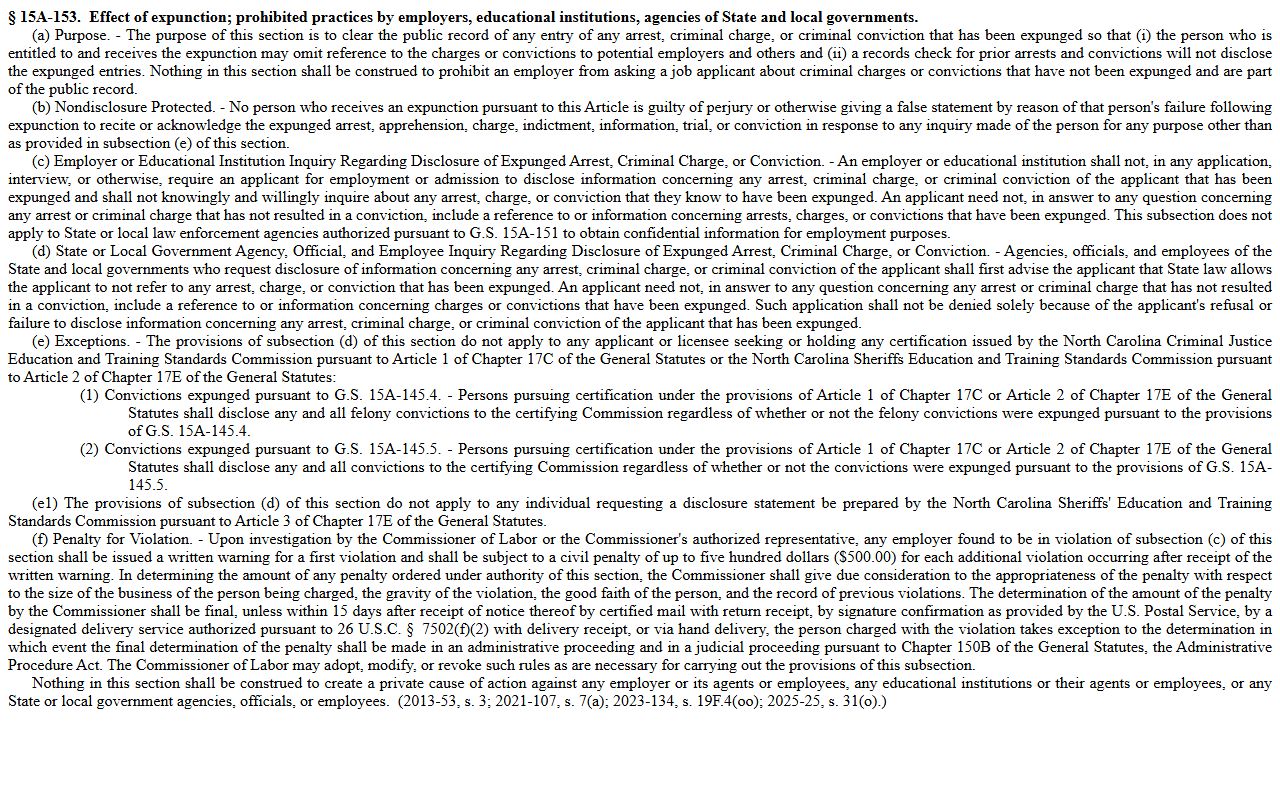
The statute is why public court search may no longer show a case after a valid expunction order is processed.
Public Access to Hertford Criminal Records
Public access begins with the Portal and the Clerk of Superior Court. G.S. 7A-109 requires clerks to keep records, dockets, files, and indexes and makes them open during regular office hours unless prohibited by law. G.S. 132-1 defines public records for state and local agencies, but court records follow judicial-branch access rules too.
Key Statutes:
G.S. 7A-109 - clerk records, files, dockets, and indexes are open unless another law restricts them.
G.S. 132-1 - public-record law applies to agency records, while court files also use judicial rules.
Restricted Hertford Criminal Court Records
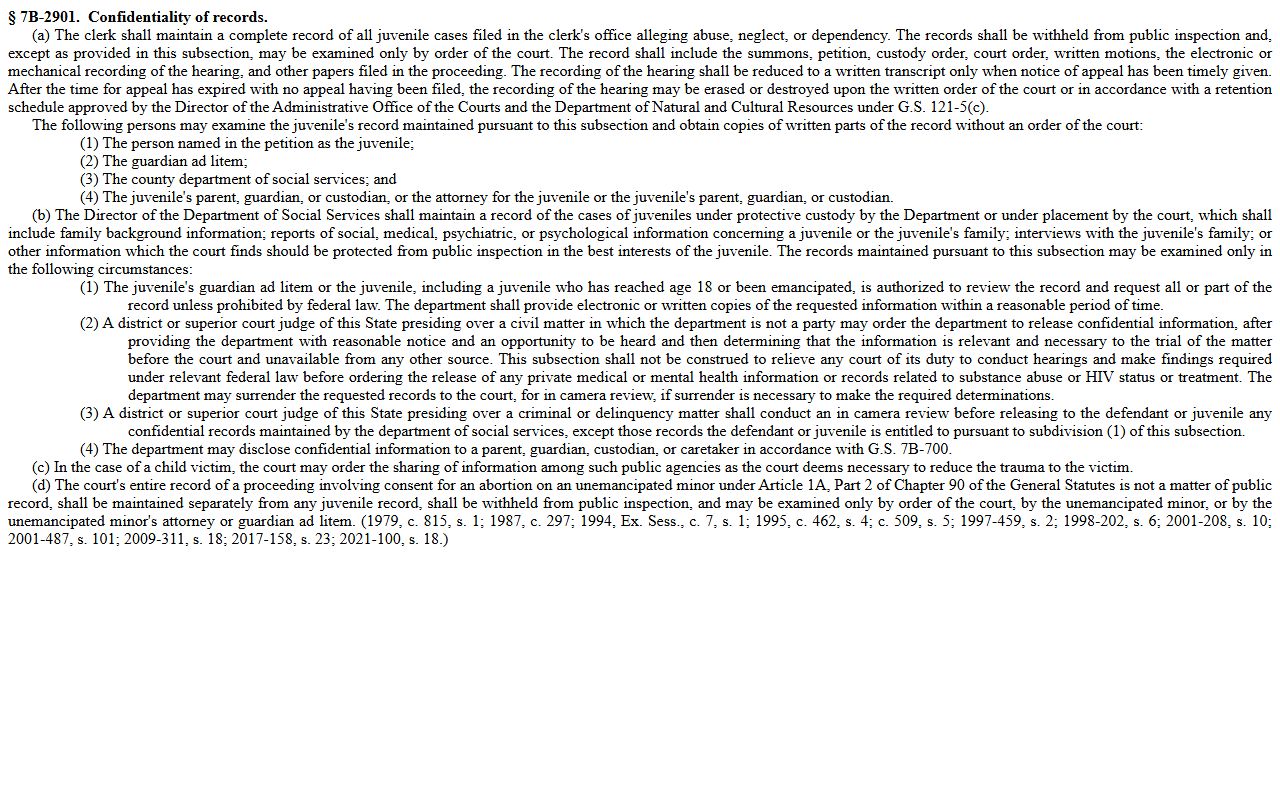
Juvenile delinquency court records are withheld from public inspection under G.S. 7B-3000. Abuse, neglect, and dependency records are restricted under G.S. 7B-2901. The assigned juvenile-record image below comes from the delinquency confidentiality statute.
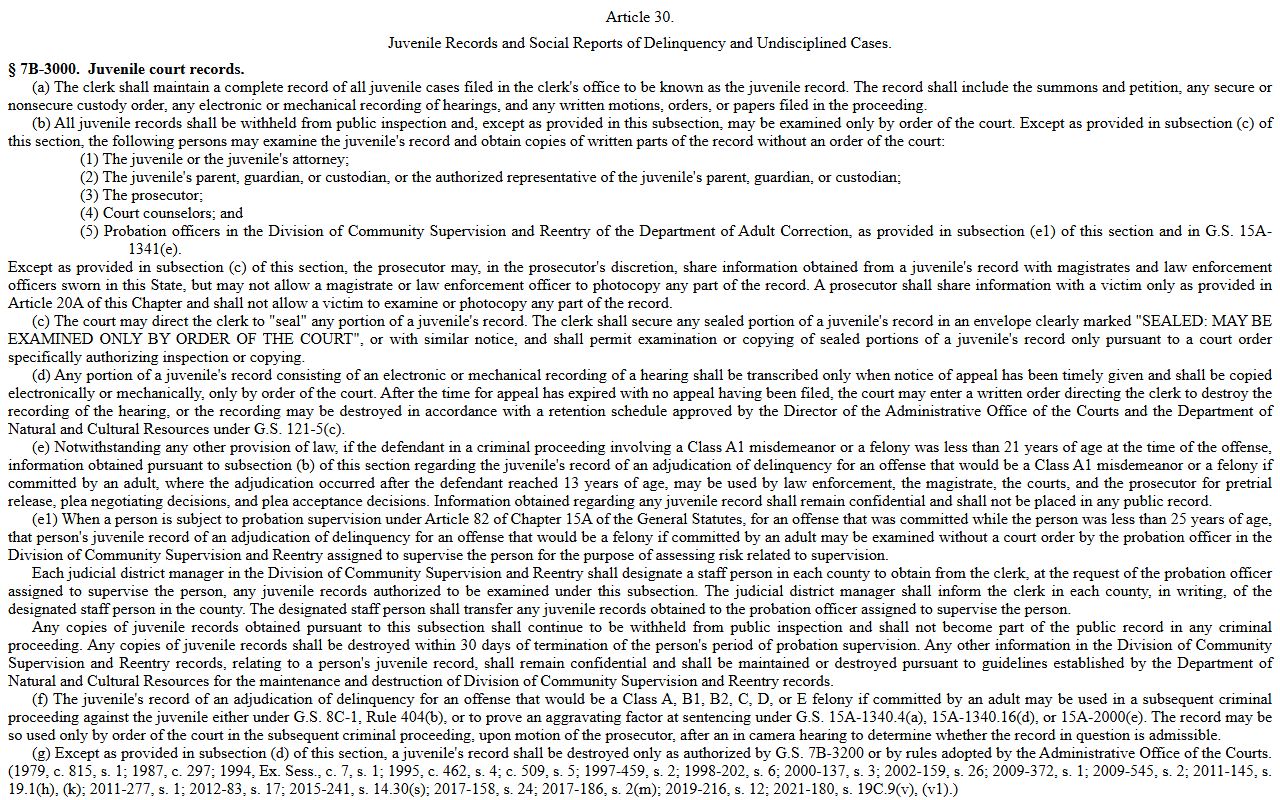
Juvenile limits mean a public criminal search should not be treated as a complete history for every person or every event.
Abuse, neglect, and dependency files have their own confidentiality rule. The assigned image source is G.S. 7B-2901.
Other restricted criminal records can include sealed cases, protected addresses, personal identifiers, mental-health material, confidential informant or investigation content, and expunged files.